The Key Components of a GrantSmarts Funding Blueprint: What You Need to Know
- grantsmartsconsult
- May 2
- 5 min read


In today’s competitive landscape, securing funding for projects, nonprofits, and businesses can feel like navigating a complex maze. Many organizations struggle to identify the right grants, prepare persuasive proposals, and manage deadlines effectively. That’s where GrantSmarts Consulting, a leading grant consultant service in the USA, comes in. Our expertise helps clients unlock funding opportunities they might otherwise miss.
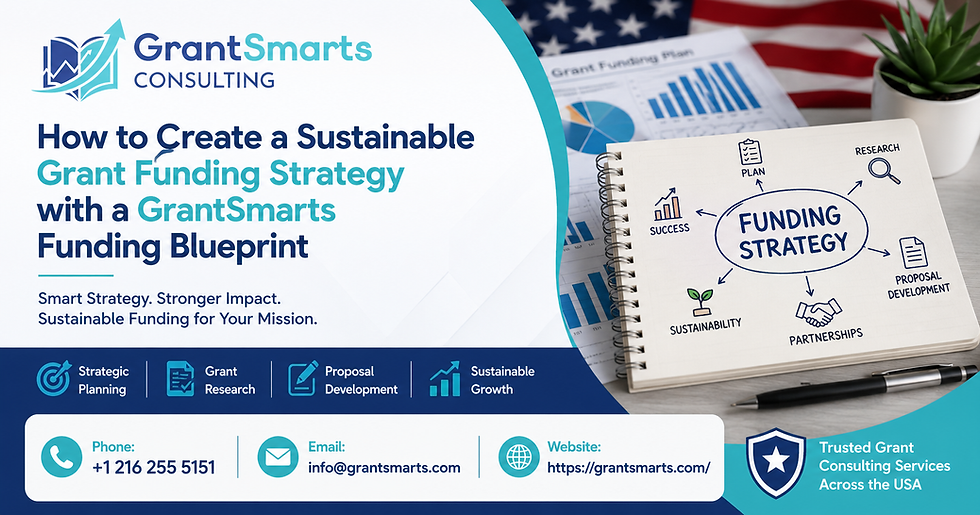
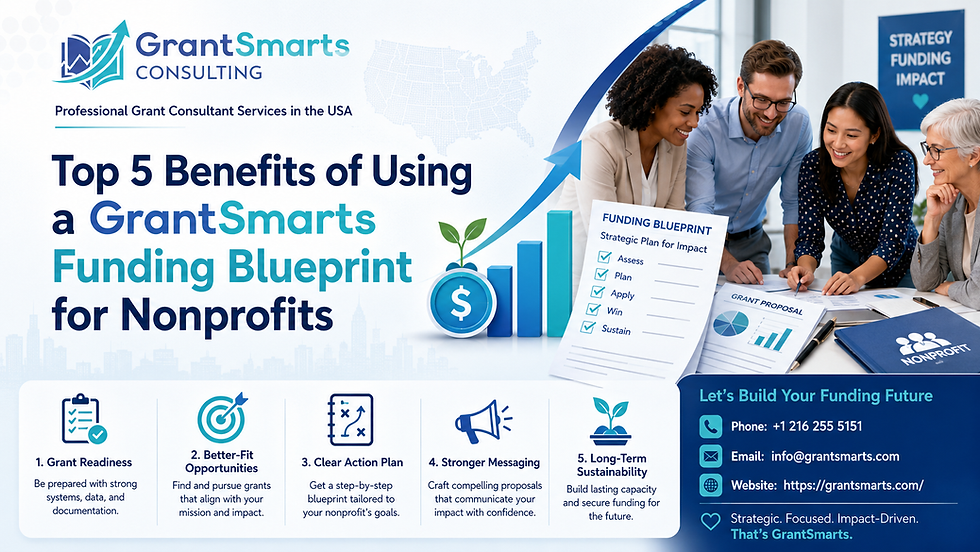
In this guide, we’ll walk you through the key components of a GrantSmarts Funding Blueprint, explaining each element and why it matters. Whether you are a nonprofit seeking federal grants or a small business looking for private funding, understanding these components can significantly improve your chances of success.
1. Understanding the Funding Landscape
Before diving into applications, it is essential to analyze the funding landscape. This includes:
Government Grants: Federal, state, and local programs that provide financial support for projects aligned with policy goals. Examples include NIH, NEA, and state-specific initiatives.
Private Foundations: Organizations like the Gates Foundation or Ford Foundation that fund projects with specific missions.
Corporate Grants: Businesses offering community grants or sponsorships to support social responsibility initiatives.
By understanding these sources, you can tailor your grant strategy to the opportunities most relevant to your organization. Additionally, staying informed about emerging trends—such as technology-driven funding or environmental initiatives—can give you a competitive edge.
Tip: Use databases like or Foundation Directory Online to research potential funders efficiently.
2. Setting Clear Objectives and Goals
A strong Funding Blueprint begins with clarity. Without clear objectives, your grant proposal may appear unfocused or unconvincing. Consider the following:
Define Your Mission: Ensure your goals align with your organization’s mission and vision.
Identify Measurable Outcomes: Funders want to know how your project will make an impact. Specify quantitative and qualitative outcomes.
Prioritize Projects: Not every idea requires funding immediately. Rank projects based on urgency, feasibility, and funding potential.
For example, a nonprofit focused on education might prioritize a literacy program over a technology upgrade if funding opportunities are more abundant in education initiatives.
3. Comprehensive Needs Assessment
Next, conduct a needs assessment to justify your funding request. This involves:
Data Collection: Gather demographic data, community needs, and project-specific statistics.
Gap Analysis: Identify current shortcomings and explain how the grant will address them.
Stakeholder Input: Engage staff, volunteers, and beneficiaries to provide insight and support.
Transitioning from objectives to needs ensures your proposal is evidence-based, making it more persuasive to funders. Remember, funders are more likely to invest in projects that clearly demonstrate a solution to a real problem.
4. Strategic Funding Plan
A strategic funding plan outlines how you will pursue grants and manage resources. It includes:
Timeline and Milestones: Track application deadlines, internal review dates, and project start/end dates.
Budget Planning: Develop a detailed budget, including personnel, materials, and overhead costs.
Diversification of Funding Sources: Avoid relying on a single source; consider multiple grants, donations, or partnerships.
Using a structured funding plan helps your organization remain organized and reduces the risk of missing critical deadlines. Furthermore, funders appreciate applicants who show careful planning and financial responsibility.
5. Crafting Compelling Proposals
The proposal itself is the centerpiece of the Funding Blueprint. Effective grant proposals should include:
Executive Summary: A concise overview of your project, mission, and funding needs.
Problem Statement: Clearly define the problem and its significance.
Project Description: Detail your approach, methodology, and expected outcomes.
Budget Justification: Explain how every dollar will be used.
Evaluation Plan: Describe how you will measure success and report outcomes.
Moreover, using persuasive, clear language is crucial. Avoid jargon unless necessary, and ensure your narrative aligns with the funder’s priorities.
Pro Tip: Proofread meticulously; a well-written proposal reflects professionalism and dedication.
6. Compliance and Eligibility Verification
Many applicants overlook eligibility requirements, leading to disqualified submissions. A GrantSmarts Funding Blueprint emphasizes:
Eligibility Checks: Verify that your organization meets the funder’s criteria.
Documentation Readiness: Ensure all required certifications, tax documents, and letters of support are prepared.
Regulatory Compliance: Adhere to federal, state, and local regulations for grant recipients.
By addressing compliance upfront, you reduce the risk of last-minute issues that could derail your application.
7. Relationship Building with Funders
Funding isn’t just transactional; it’s relational. Building relationships with funders can:
Increase the likelihood of repeat funding
Offer insights into upcoming opportunities
Provide feedback for proposal improvements
You can build these relationships by attending funder events, requesting informational interviews, or providing progress updates on prior projects.
8. Monitoring and Reporting
A successful Funding Blueprint includes a plan for ongoing monitoring and reporting:
Track Milestones: Ensure your project stays on schedule.
Document Outcomes: Record quantitative and qualitative results.
Submit Timely Reports: Funders require updates, and timely reporting can position your organization favorably for future grants.
Regular reporting demonstrates accountability, a factor that funders highly value.
9. Leveraging Technology for Grant Management
In the digital age, technology streamlines grant management:
Grant Management Software: Tools like Fluxx or Foundant help organize applications, deadlines, and communications.
Data Analytics: Analyze trends in funding success and optimize future proposals.
Integrating technology ensures efficiency and improves the overall effectiveness of your Funding Blueprint.
10. The Role of Professional Grant Consultants
Navigating the complex world of grants can be overwhelming. That’s why many organizations turn to professional consultants like GrantSmarts Consulting. Our services include:
Personalized grant strategy development
Proposal writing and editing
Budget preparation and review
Compliance checks and reporting support
By working with experienced consultants, organizations can maximize funding success while minimizing errors and wasted effort. In short, professional guidance can be the difference between a funded project and a missed opportunity.
11. Continuous Learning and Adaptation
Finally, a GrantSmarts Funding Blueprint encourages continuous improvement:
Post-Application Review: Assess successes and challenges from previous applications.
Training and Workshops: Stay updated with new funding opportunities and proposal techniques.
Adapt Strategy: Modify your blueprint based on results and evolving organizational goals.
A culture of learning ensures that your organization remains competitive and resilient in securing funds.
Why Choose GrantSmarts Consulting in the USA?
If you are seeking expert grant consultants in the USA, GrantSmarts Consulting offers:
Proven track record with multiple successful grants
Expertise across nonprofit, business, and academic sectors
Customized solutions tailored to your goals
Comprehensive guidance from strategy to reporting
Our goal is to simplify the grant process and help clients unlock the funding they deserve.
5 Frequently Asked Questions (FAQs)
Q1: What is a Funding Blueprint?A: A Funding Blueprint is a strategic plan outlining your organization’s approach to identifying, applying for, and managing grants. It ensures clarity, efficiency, and alignment with funding opportunities.
Q2: How does GrantSmarts Consulting help organizations?A: We provide expert guidance on grant strategy, proposal writing, budgeting, compliance, and reporting, increasing your chances of securing funding.
Q3: Can small businesses benefit from grant consulting services?A: Absolutely. GrantSmarts helps small businesses identify funding opportunities, craft persuasive proposals, and manage grants effectively.
Q4: Do I need prior experience with grants to work with consultants?A: No experience is necessary. Our consultants guide you through every step of the process, making grant funding accessible for all organizations.
Q5: How do I start working with GrantSmarts Consulting?A: Contact us via our website or phone. We will assess your needs, discuss opportunities, and develop a customized Funding Blueprint.
Conclusion
In conclusion, the GrantSmarts Funding Blueprint is a comprehensive approach to funding success. By understanding the landscape, setting clear goals, conducting needs assessments, crafting compelling proposals, ensuring compliance, building funder relationships, leveraging technology, and continuously improving, organizations can maximize their grant potential.
Whether you are a nonprofit, a small business, or an academic institution, partnering with GrantSmarts Consulting provides expert guidance to secure funding efficiently. In a competitive funding environment, having a strategic, professionally supported approach can make all the difference.
Take the first step today. Consult with GrantSmarts Consulting and transform your funding opportunities into reality.
Contact Us for Your Grant Consultants Service in USA
Company Name: GrantSmarts Consulting
Address: 7055 Engle Rd Building 6 601, Middleburg Heights, OH 44130, United States
Phone: +1 216 255 5151
Visit Our Website: Click Here

Comments